Keep up with the updates:
AdventureDoor • Reviews • April 7th
April 7th
| Developer: | Geoff Lynas |
|
| Released: | 1991 | |
| Genre: | Sci-Fi | |
| Graphics: | Text-Only | |
| Perspective: | n/a | |
| Gameplay: | Parser |
 |
Note: this is a ZX Spectrum game. |
Post-apocalyptic something is a bad thing. What exactly is "the thing" in the game is unclear, but apparently it's a very destructive thing. And presumably something happens on April 7th. Or did happen. Or may happen. Related to the thing. Whatever the thing might be.
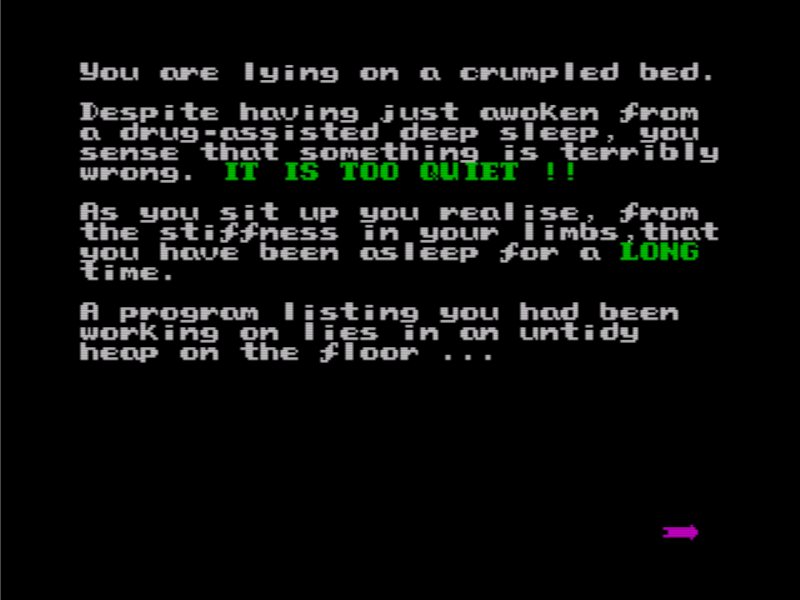
Let's backtrack a step, if we can. So the player/protagonist has been selected as some kind of an important person to survive whatever apocalyptic thing is about to happen. Then it happens. And the player/protagonist has to spend an eternity in an underground shelter. But then, something goes horribly wrong inside that shelter, and the player/protagonist must try to find his way out of the shelter. Because whatever happened on the surface is apparently not as bad as whatever happened in the shelter some time ago. Maybe on April 7th?
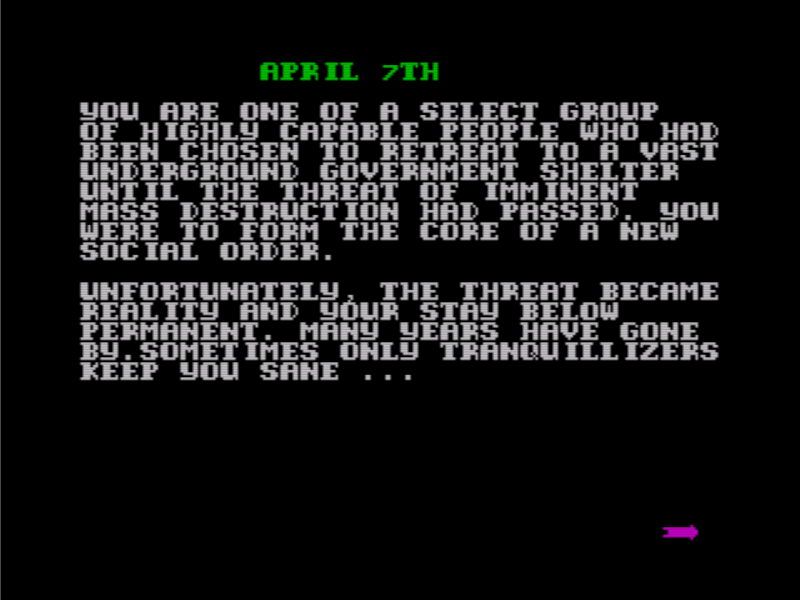
So this text adventure doesn't give many explanations and doesn't try to build much of a background story. Which sometimes can be good. Whether it is good here is debatable. In any case, the whole concept seems to be an escape room scenario, where the player must try to get out of the shelter that was once designed to be an escape from the apocalypse, be it a nuclear war, an asteroid impact, or alien invasion. This means that the player will be entering many spaces, room after room, where something potentially useful can be found and collected.
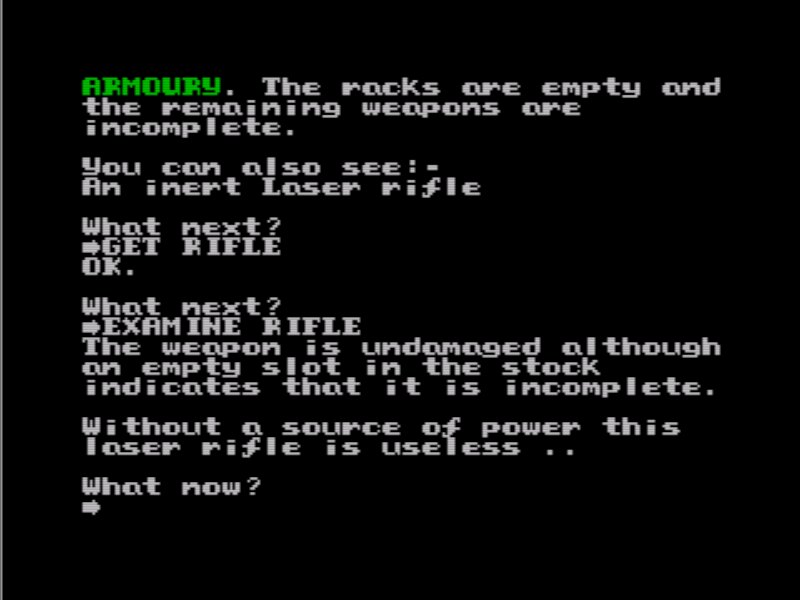
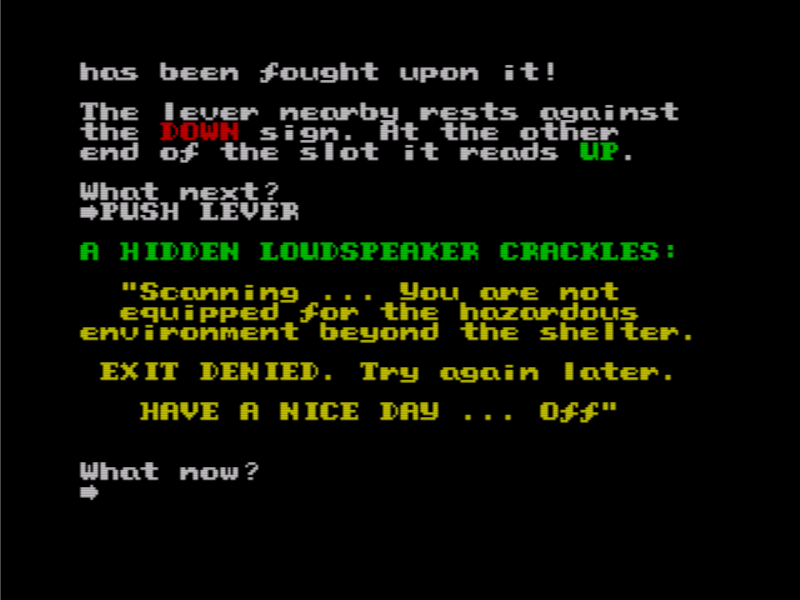
The player actually starts in his own room inside the facility carrying nothing, and from there the player must map out the situation and pick up necessary items. And both of those are meant as literally as possible. The shelter has many rooms, corridors, and levels, so mapping it by actually drawing a map is almost unavoidable. Picking up items, on the other hand, is literally the core of the game. Some kind of computer prevents leaving the facility unless the player is carrying required items. In fact, the entire scoring system in the game is based on what happens to be in the inventory. The score percentage goes up by picking items needed for survival, but it can also go down by dropping some necessary items! This can get a bit confusing, especially as getting the perfect score requires picking up, then dropping, and later picking up again certain items. There are also some red herrings, items which seem to be necessary and useful but in the end are not.
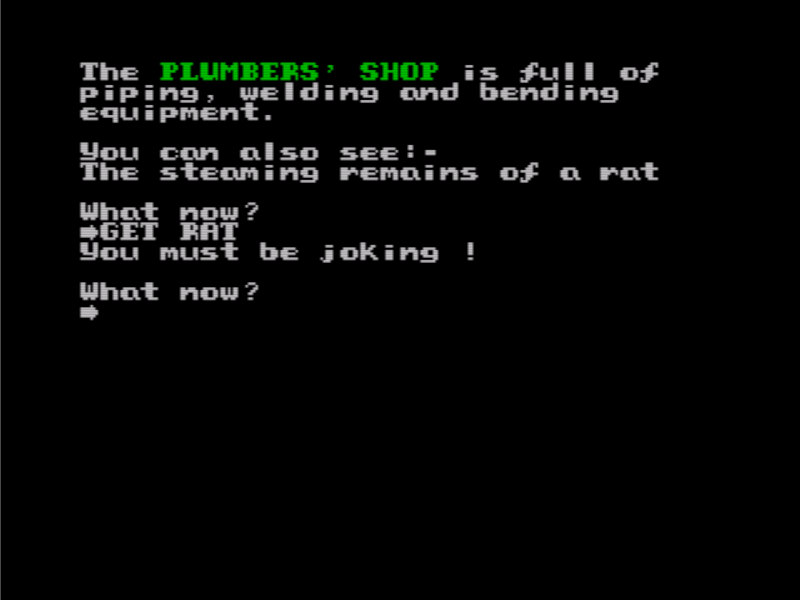
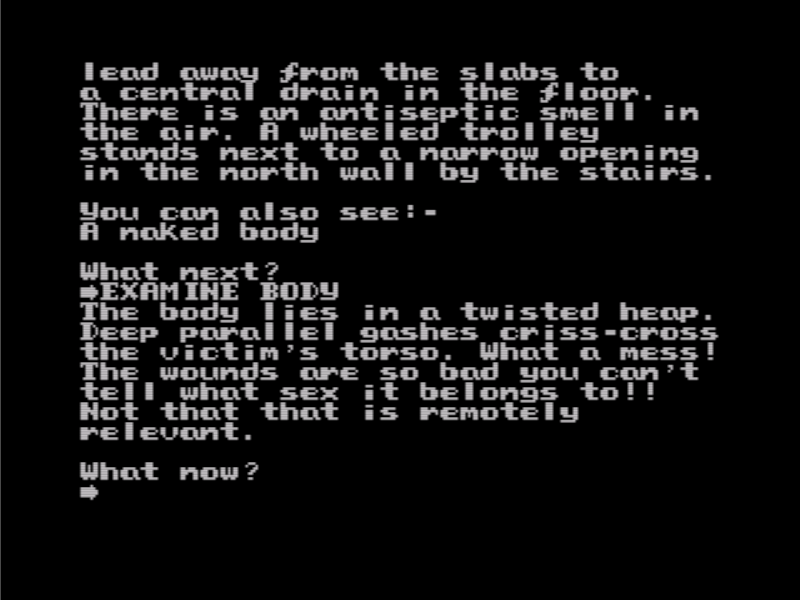
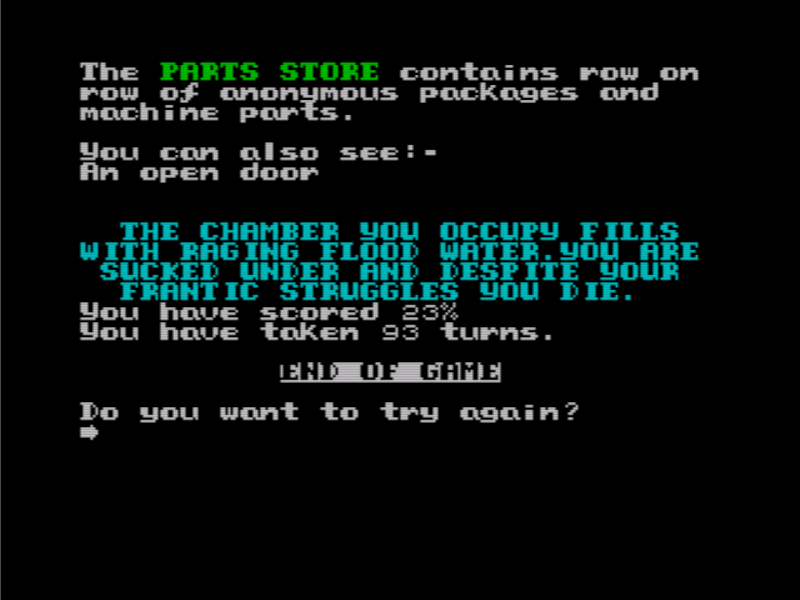
There is a sense of urgency in the game. There are some invisible timers in the game that can get the player killed unless the player can act and react quickly, or has cleared some areas before they become inaccessible. There are also several ways to get killed in the game, based on what the player does or doesn't do. So overall, the game is a very traditional kind of game. Lots of areas to explore and map, items that need to be picked up and used, ways to get killed, and a score to show progress. The only thing that is missing from the most traditional concept is an actual maze. It is quite easy to get lost without drawing a map, so in a sense the game is one big maze, although the game never tries to deliberately make the player get lost.
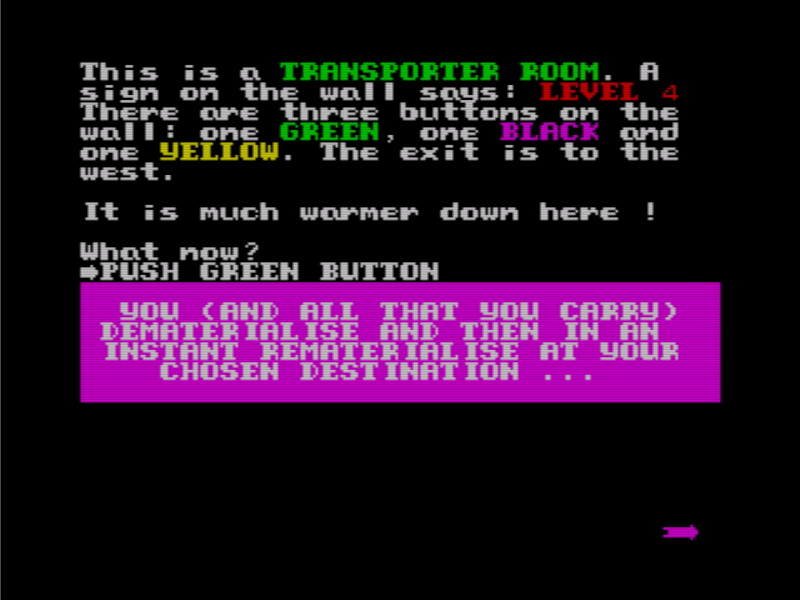
The game is actually very informative about many things. Room descriptions happen automatically when entering a room, and many of them contain information about which directions are accessible. In some cases there are also different colours to highlight something, such as when transporting from one level to another; each level has its own colour code. So the game at least tries to give a fair chance to successfully pass it. Even with that, the game is quite difficult. There's a lot of backtracking, and to make things worse, the inventory is not unlimited. With some superficially useful, but in the end useless, items in the game, it's very challenging to know what is really needed and what is not. Interestingly, some items can be worn, in which case they show up as inventory items but don't take up inventory space.
This kind of premise and game design is kind of interesting, because it has a lot of potential. But much of that potential is actually lost in/on April 7th. One would expect that there would be a story of some kind that reveals itself when getting further into the game. But no, not really. When the player manages to escape the facility, the story is almost as unclear as it was in the beginning. The science fiction setting gives an excuse why the player can teleport from level to level instead of climbing stairs, but it doesn't go much further than that.
When the player is out of the facility (minor spoiler alert!) carrying items that are probably good enough to last for a few days, that's where the real adventure and story would begin. In this case, that's where it ends. Like said, the game is an escape room scenario, and once the player has escaped, the game ends. It's a shame because there would be a story to tell somewhere there, but it is never told.
What the game offers is a text adventure that is quite possibly a bit more polished than an average adventure, but with some annoying game mechanics, it is never that much fun to play. Those who are big fans of escape room games, trial and error, drawing maps, and dying a few times to learn how to stay alive may like this one a lot. Those who like adventures as interactive stories with good puzzles won't be as happy to go through this one.
And why April 7th? Out of 365 days a year, why that specific date? We may never know.
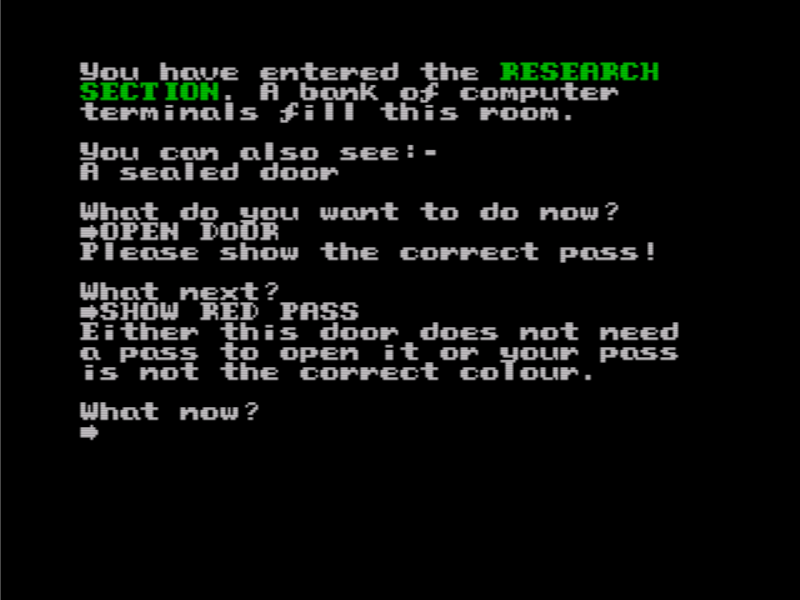
Image gallery