Keep up with the updates:
AdventureDoor • Reviews • Broken Sword: The Shadow of the Templars
Broken Sword: The Shadow of the Templars
| Developer: | Revolution Software |
|
| Released: | 1996.10.14 | |
| Genre: | Mystery | |
| Graphics: | Cartoon / 2D | |
| Perspective: | Third person | |
| Gameplay: | Point-and-Click |
 |
Note: this game can be played with ScummVM software. |
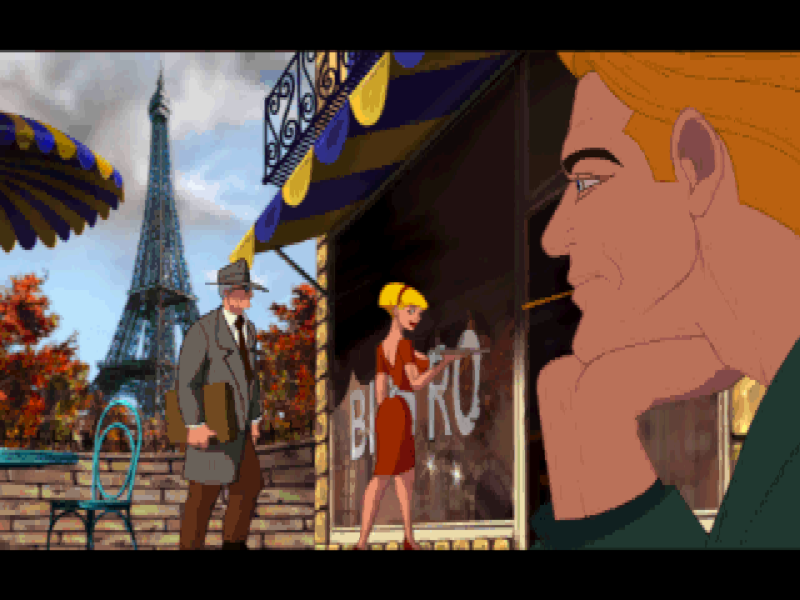
"Paris in the fall, the last months of the year and the end of the millennium. The city holds many memories for me - of cafés, of music, of love... and of death."
And so begins this extraordinarily engaging adventure, which, like the title suggests, has the protagonist involved in a mystery which is somehow tied to ancient Knights Templars and an ancient relic, broken sword. The game has been released under the name Circle of Blood in the USA, which really tells very little about the actual game.
Unlike the alternative name might suggest, there's no action in the game. It's a very traditional, yet in its own way even innovative, point-and-click adventure game. The hero of the story is an American tourist in Paris, George Stobbart, and in the best possible Hitchcockian tradition, gets drawn into a murder mystery as an innocent bystander. There are also all possible film clichés one can think of: murders, conspiracies, ancient artefacts, secret cults, and a girl to impress. And the game really makes the most out of the material that is in it.
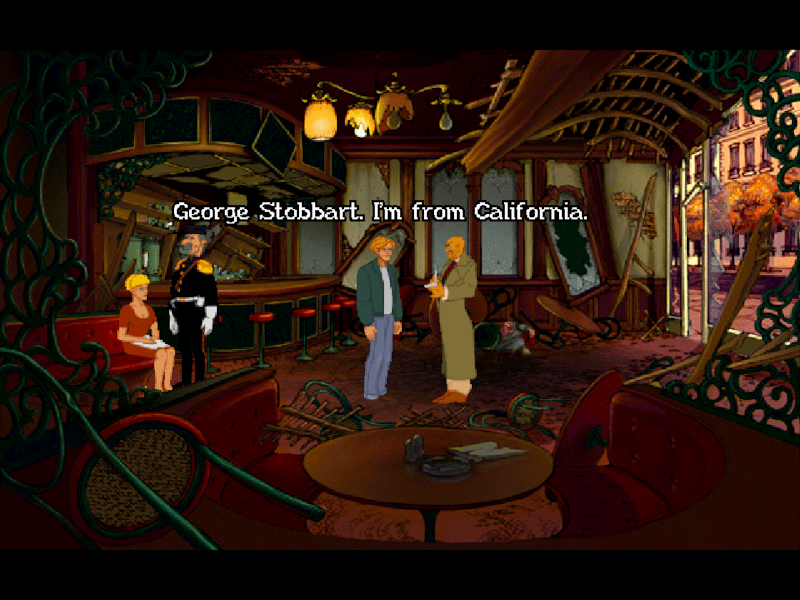
It all begins when George Stobbart is having a nice drink in a Parisian café, and a clown commits a murder by bombing the café. Yes, a clown. Murders by bombing. From the very first moments it is obvious that the game isn't dead serious. In fact there is a load of humour in the game, not enough to push it into the comedy genre, but certainly enough to give the player a good chuckle or two more than once.
While the motivation for George Stobbart to start investigating the murder he happens to witness is kind of weak, the story soon becomes so immersive, engaging, and oftentimes amusing that it's easy to forgive and forget such minor things. Because the story has him going from one exciting location to another, from one country to another, and then back, meeting all kinds of weird characters on the way. Still, to overanalyse it: why does Sherlock Holmes solve crimes, and why does Indiana Jones search for old relics? Because Holmes is a detective, and Indy is an archaeologist. So why does George Stobbart do all that? Well... just because.
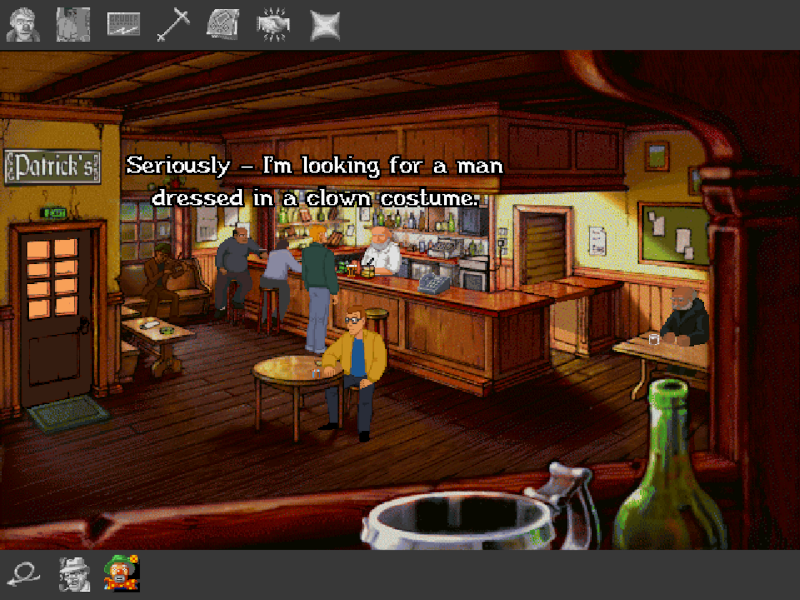
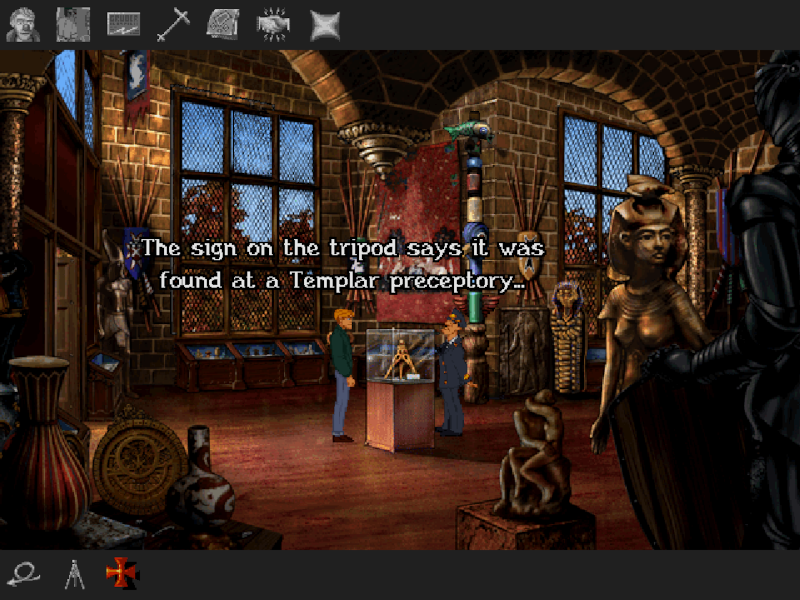
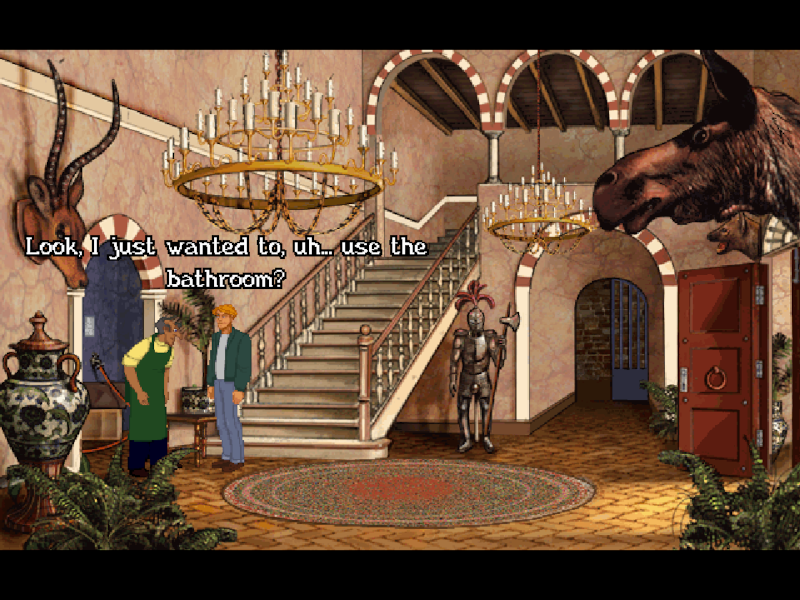
Some of the locations in the game look breathtakingly immersive, and even beautiful, in the cartoon-styled, best possible game art anyone can imagine. Paris, Ireland, Scotland, Spain, the Middle East... so many places to visit and explore! Maybe some of the globetrotting has been "borrowed" from Indiana Jones adventure games, but who cares? It works perfectly there, and it works perfectly here.
Therein lies a small problem too. No one really expects adventure games to be showcases of foolproof logic, there is a reason why the term "moon logic" was invented, but in a game like this some parts just feel silly. Not in the good kind of way silly, as in the character of George Stobbart cracking sarcastic comments about things around him, but just too silly. For example, when the protagonist goes from one country to another and then returns, some of the NPCs have been standing in the same place in Paris for hours, or even days, without moving an inch. Or a pixel. Or when the hero of the game finds somehow means to buy aeroplane tickets to do international travelling, but then doesn't have a penny in his pockets to buy an item that he needs to solve a puzzle. Very typical adventure game stuff, nothing strange about any of that. But in a game that is much better than an average adventure, things like that feel even sillier than in a random adventure game otherwise.
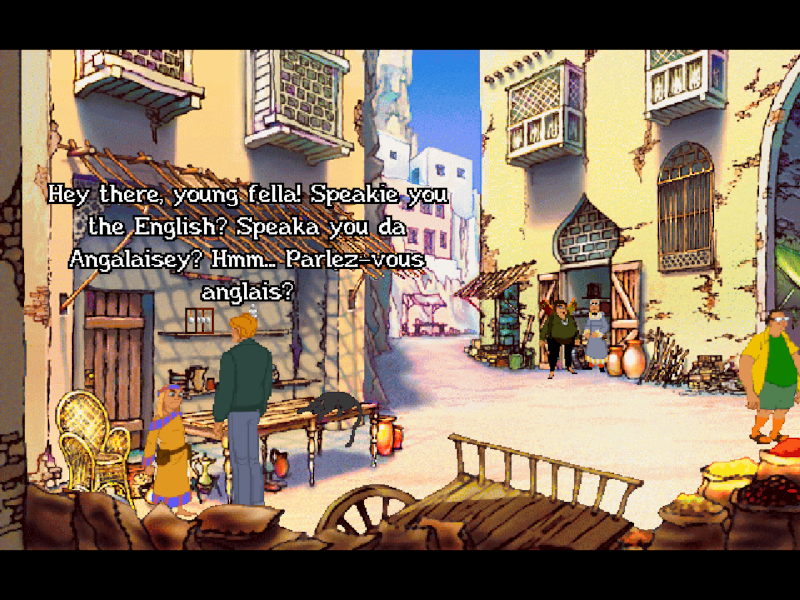
Most of the puzzles and situations are somewhat realistic, so it's very rare that the player needs to resort to random item-on-item combinations to find which things happen to solve the moon logic puzzle at hand. Some of the silliness is intentional and works quite well. When a random tourist goes looking for a clown to solve a murder that is not related to him in any way, carrying items like a clown's nose in his inventory, it's very clear that some discussions and situations are there just to be funny. In fact, almost every action in the game has a unique response, so it's really worthwhile to talk to everyone about everything, if for no other reason than just to see what reaction follows.
While all that sounds like it might be a terrible mess of mismatching components, all aspects are actually perfectly balanced. There is a lot of serious stuff, like historically accurate information about the Knights Templars. There are ridiculous situations like looting things from toilets to solve puzzles. There are jokes involving people from different backgrounds and cultures interacting with each other. And there are even some situations which are dangerous and will get the player killed, and going back to loading an earlier save. It's not necessary to save as early and as often as in the old Sierra games, but some deaths in the game do come without a warning. Perhaps that might be the only thing that is not quite in balance with the rest of the content, but it's obviously debatable, as many adventurers appreciate the risk of in-game deaths.
The game is very professionally voice acted, with everyone except George Stobbart (or Rolf Saxon, the actor) doing fake accents. It works well enough, although it is painfully obvious that some different characters have been voiced by the same actors, which makes it sound a bit cheap. With the game having such great graphics, well-made animations, and writing that offers several hours of playing time, it's a bit surprising that the developers didn't find more actors to do different characters.
It feels a bit nasty to criticise such a great game, but while at it, there are some other things that are a bit annoying too. The game control is very easy, with the cursor being context-sensitive. Left-clicking performs an action which depends on the icon that is automatically displayed, while right-clicking inspects a hotspot. Sometimes the game requires right-clicking, even though the contextual action for the left-clicking is a magnifying glass. That doesn't make much sense; in fact, one would expect using a magnifying glass to give better information than right-clicking, which doesn't even have any of its own icons. And at some point, quite far from the beginning, the game suddenly expects the player to combine items in the inventory, even though up to that point nothing like that was needed. And there is an unfair puzzle or two in the game. Very standard adventure game mechanisms, but when they appear all of a sudden, they don't feel intuitive. In some cases the game logic also works backwards: actions that the protagonist is doing make sense after those actions have been performed.
In a long game like Broken Sword, it is understandable that the game design may not be completely flawless everywhere, but because most of the game is so great, it's a pity that it's not 100% perfect. Towards the end of the game the difficulty increases, which can also be read as the game unfortunately resorting to some traditional design choices. Like needing to perform the same action more than once, doing some pixel hunting, and doing thing A before thing B although there's no real correlation between the two. Fortunately, all those cases in the game are very few indeed.
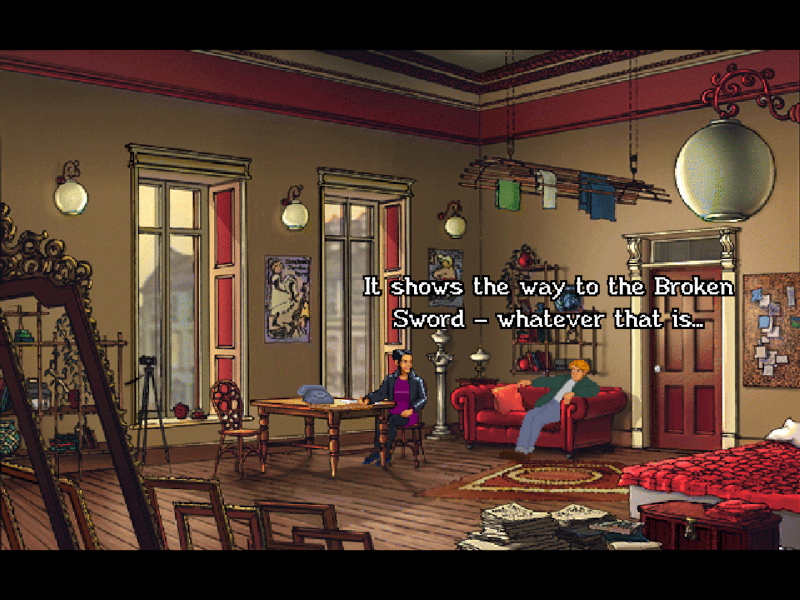
Whatever minor complaints there might be about the game, they are in the end a moot point. The game is great. You, as George Stobbart, want to explore the game world and solve different kinds of puzzles. The game also has a very nice spin on the damsel in distress trope. Nicole Collard, or just Nico, is the girl whom George meets in the beginning. She is a journalist working on a story related to the plot. Most of the time she stays at home, and George goes back to her or phones her every now and then. In some places she is needed to advance further in the game, but the actual adventuring is left to George.
All things considered, there's no need to be shy about this. Broken Sword is simply one of the best adventure games ever made. It's not perfect, but not very far from it. Everything works, even things that can be criticised are things which few games have done better. The game combines the best parts of thriller and mystery films with the best parts of adventure games to create an experience that very few adventure gamers would care to miss. The key to success here is the very delicate balance between a serious mystery and humour that the game manages to achieve. With lots of locations to explore and puzzles to solve, it's exactly what most adventurers are looking for. It's rare to be able to say that a game is undeniably great, but those who like point-and-click adventure games are going to do just that.
Broken Sword is great.

Image gallery