Keep up with the updates:
AdventureDoor • Reviews • Hi-Res Adventure #1: Mystery House
Hi-Res Adventure #1: Mystery House
| Developer: | On-Line Systems |
|
| Released: | 1980.05.05 | |
| Genre: | Mystery | |
| Graphics: | Pixel art / 2D | |
| Perspective: | First person | |
| Gameplay: | Parser |
 |
Note: this game can be played with ScummVM software. |
 |
Note: this is an Apple II game. |
| The game is also available for FM-7, PC-88, and PC-98. |
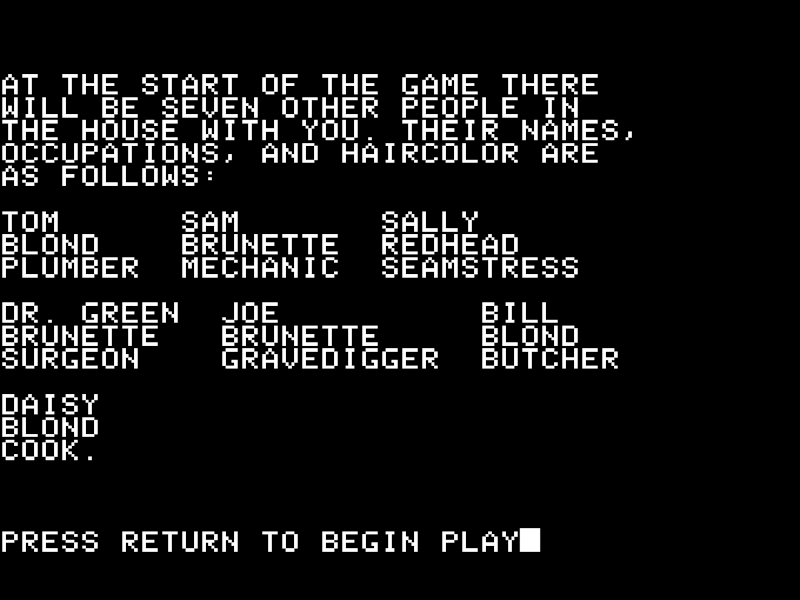
"Adventure is one of the most facinating [sic] and challenging games available for your Apple computer. Winning is quite a challenge in a game where it may take hours to move and weeks to solve a puzzle. Hi Res Adventure #1 ("Mystery House") takes place in an old house with many rooms. As you enter the house, seven other persons will be in the living room. Eventually they are dispersed around the house and you start finding them - dead! You must find the killer before he (she?) ends up killing you."
If adventure games officially start with Colossal Cave Adventure, then graphical adventure games start officially here. Whether Hi-Res Adventure #1: Mystery House, or simply Mystery House, actually is the very first may be a question that will never be solved. There is ASCII graphics and everything to confuse matters. Be that as it may, Mystery House is one of the first ones, and at least according to its creators, the very first graphical adventure game. Meaning that you actually see rough graphical presentations of the situations that the player is involved in.
And the player is involved in a murder mystery, which shamelessly borrows the basic premise from Agatha Christie's And Then There Were None novel. To put it in a sentence: the protagonist enters a house where people start getting murdered, and the goal is to find the culprit and get out, alive.
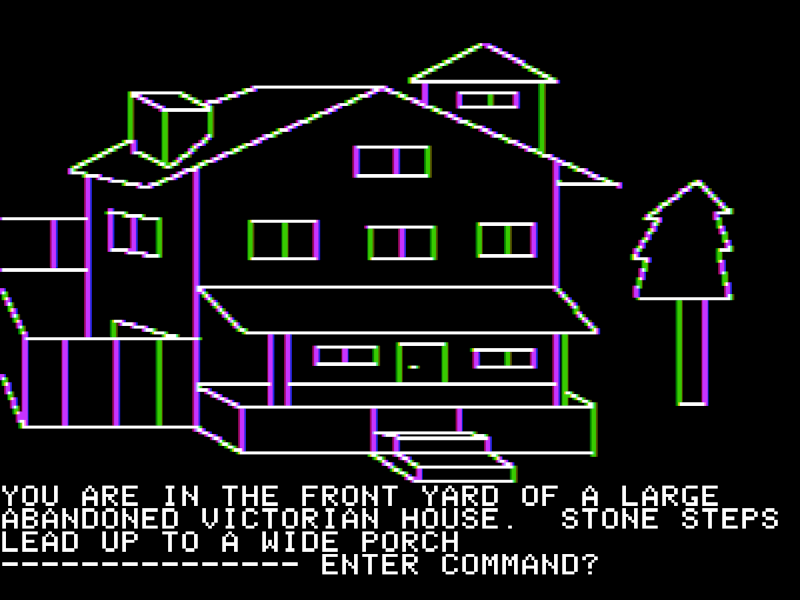
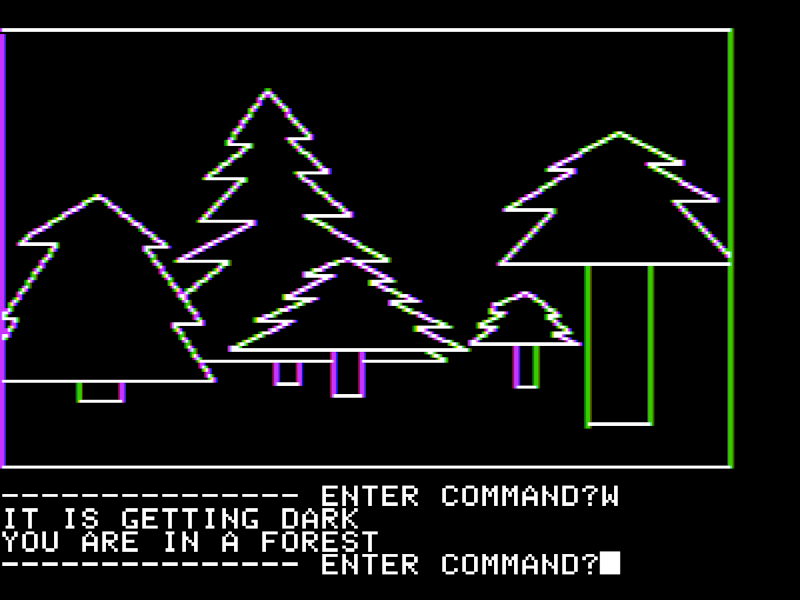
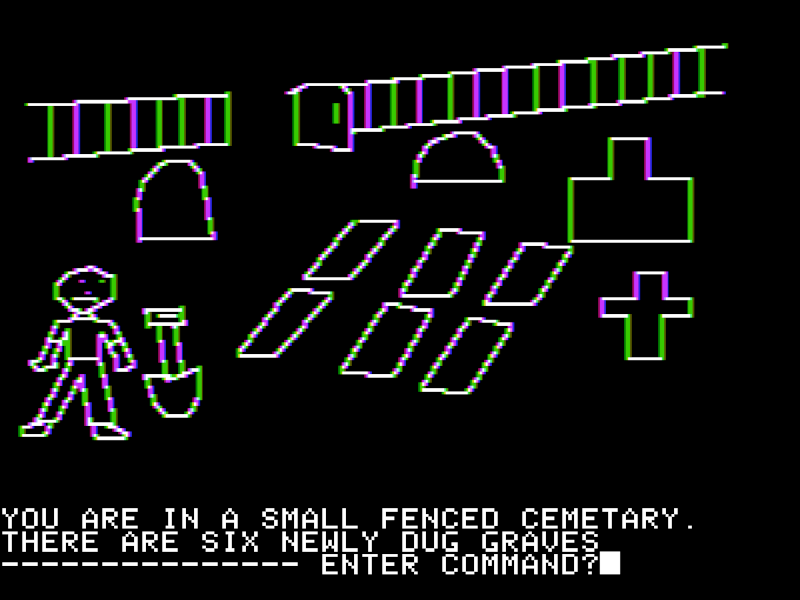
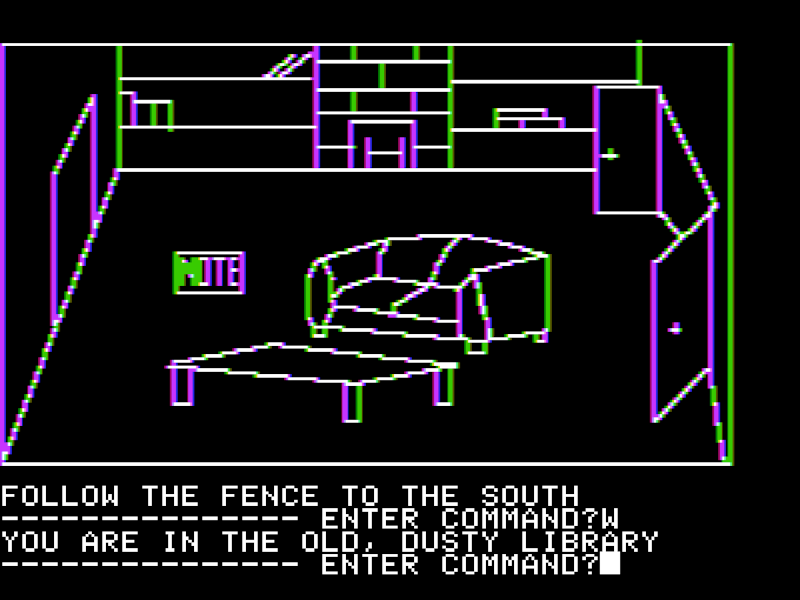
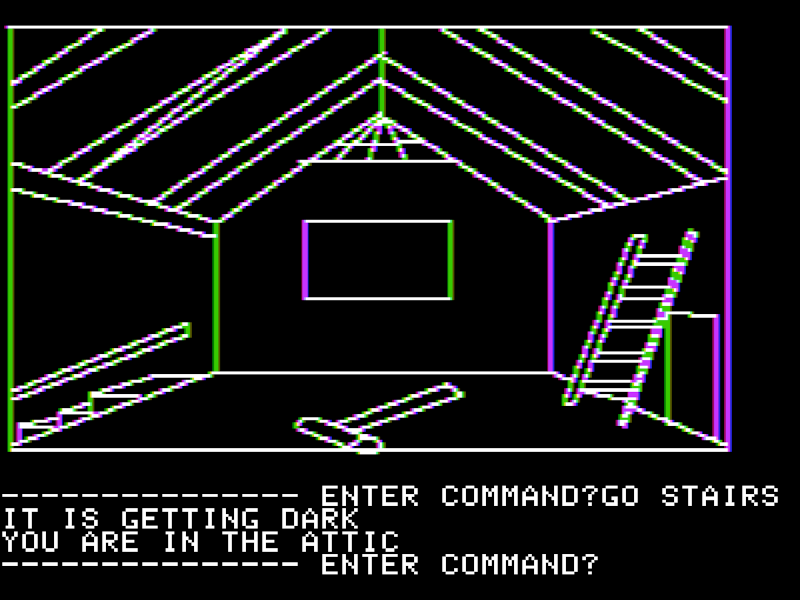
Even though "hours to move" and "weeks to solve" are very inflated descriptions, it takes some time to go through this adventure. Ironically the graphical element, which in some cases helps, such as seeing items that can be picked up, also confuses the player in Mystery House. Where in text-only adventures the player makes a mental map of the surroundings (and some actually draw lines on paper), in this mysterious house the graphics have been drawn by the developers. Which would otherwise be a big help, except for two things. The first one is a minor complaint. The graphics are very crude, and sometimes it is difficult to know what it all is supposed to represent. A thing that looks very much like a fir tree is described as a pine tree, and so on. But that's not a big problem, because in many cases the parser command LOOK explains it.
The second one is a serious complaint, however. "In general the top of the screen is north, the bottom is south, the left side is west and the right side is east. Because of the difficulty of drawing doorways to the south or the bottom of the screen, there are one or two rooms where the doorways do not match up to the normal directions." That is how the developers describe the graphical orientation, and the problem, in the in-game text. There is nothing that will tell the player which rooms are "normal" and which ones "do not match". In a traditional text-only adventure this is going to cause absolutely no problems – everyone is going to track orientation in their own mind, or on a piece of paper. But in Mystery House the graphics in the game are actually going to distract from that, and if the graphics is not reliable, then it's actually possible to get lost. Maybe for hours, maybe for weeks, or maybe until frustration kicks in and a walkthrough will be consulted.
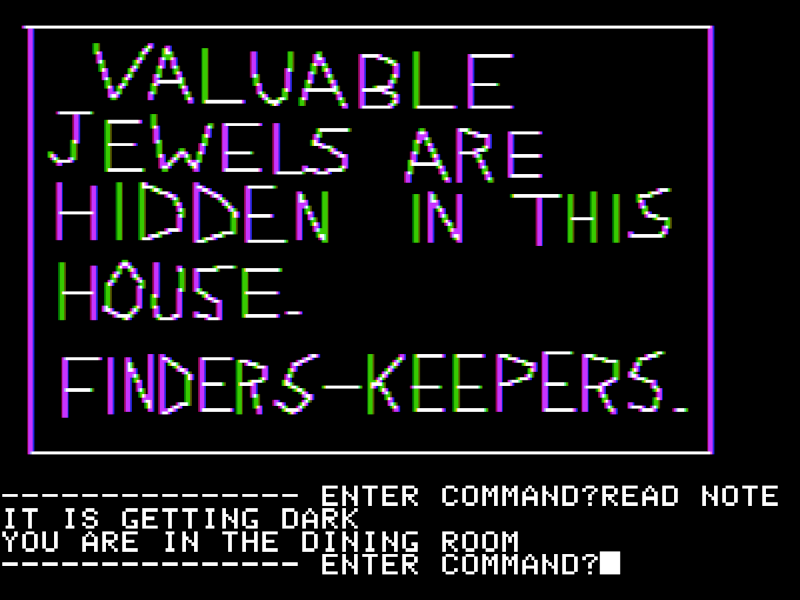
An additional challenge is that some elements in the game are very random and don't follow any real logic. For instance, in order to successfully escape from the house, the player must at one point exit and re-enter the house, so getting out of the house isn't the actual challenge that must be won, even though the game makes it very clear that the front door is locked after the player enters the house. And there's really no actual narrative about why people are getting murdered in the house. They just keep dying, and someone is the culprit. And again, finding out the culprit doesn't actually win the game, so in order to reach the successful game over, a series of things must be done, but it's unclear what exactly. And there are notes about a hidden treasure too. So the end goal doesn't make perfect sense. It's not escaping the house, it's not catching the murderer, and it's not finding the treasure, but all of those things. So accomplishing one of the goals doesn't mean the end of the game, which is causing these logical problems, such as being able to go outside even though you are supposed to be locked in.
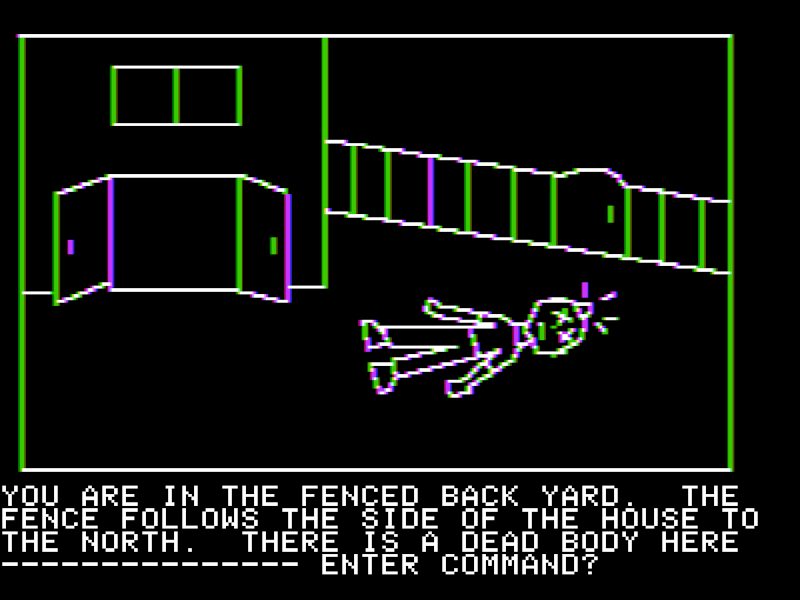
The parser does its job but clearly isn't the best parser ever. There are some funny things in it, such as typing in profanities will cause the game engine to be offended and choose not to play with the player! As funny as it is, it doesn't compensate for the lack of synonyms that the parser understands – or doesn't in most cases. Some parser choices don't make sense. For example, UP STAIRS is recognised, but DOWN STAIRS isn't. A good idea is that the graphical elements can be turned on and off by hitting the enter key. This is useful for reviewing a few of the latest commands, or if the graphics get too distracting and the player simply wants to play a text-only adventure. Which obviously would miss the main attraction of this title, the novelty of the graphical adventure concept.
Doing stupid things in the game can get the player killed, causing an unwanted game over. In some cases the line between success and failure is very thin. There is one part in the game where the player must type exactly the correct parser command, failing to do that will result in a game over with no second chance to correct the mistake. Typing something general like the LOOK command in that situation will automatically result in the player dying. The situation can't really be avoided because being in that situation has to happen in order to solve the game. Challenging for sure, but not necessarily fair. Saving and reloading is a necessary habit in the game.
So what's the bottom line here? As an innovation, the graphical element is interesting, but it doesn't quite work. It should be considered a prototype, with more successful implementations coming out later in time. The game is challenging, but the challenge doesn't really come from it being so good, but rather from it being unpolished. As an alleged landmark in game development it's an interesting thing to go through, but players who are looking for an inspiring adventure challenge can find other, often better alternatives. With better graphics, especially better and more consistent orientation, Mystery House would be a better experience.
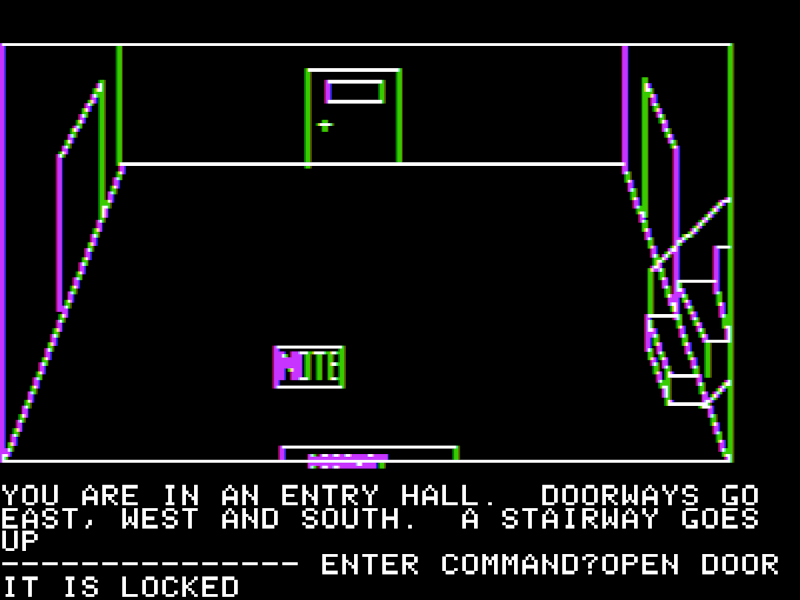
Image gallery