Keep up with the updates:
AdventureDoor • Reviews • Hi-Res Adventure #2: Wizard and the Princess (a.k.a. Adventure in Serenia)
Hi-Res Adventure #2: Wizard and the Princess (a.k.a. Adventure in Serenia)
| Developer: | On-Line Systems |
|
| Released: | 1980.09 | |
| Genre: | Fantasy | |
| Graphics: | Pixel art / 2D | |
| Perspective: | First person | |
| Gameplay: | Parser |
 |
Note: this game can be played with ScummVM software. |
 |
Note: this is an Apple II game. |
| The game is also available for Atari 8-bit, Commodore 64, DOS, FM-7, IBM PCjr, PC-88, and PC-98. |
Hi-Res adventures return. This time the player gets to be a happy wanderer passing through a village in the land of Serenia. (And from that comes the alternate title "Adventure in Serenia".) The villagers (who are never seen in the actual game but are described in the manual) are shaken because the lovely Princess Priscilla has been abducted by the great and dreadful wizard, Harlin (no relation to Renny Harlin, presumably). The obvious goal for the player is to go to the wizard's hideout, save the princess, and live happily ever after. The usual story.
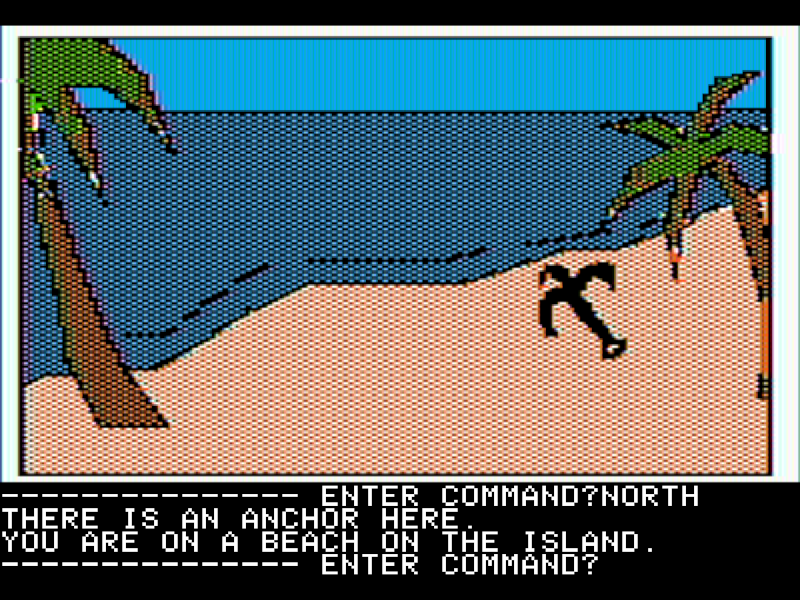
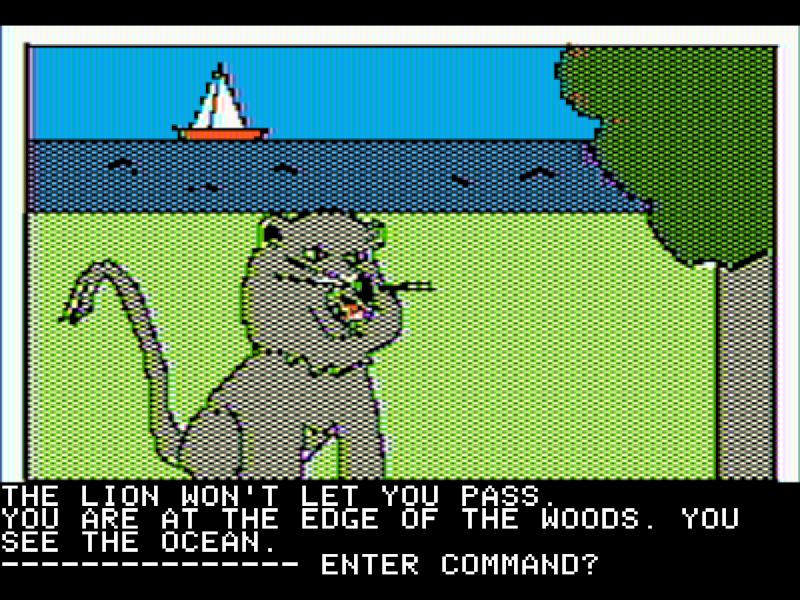
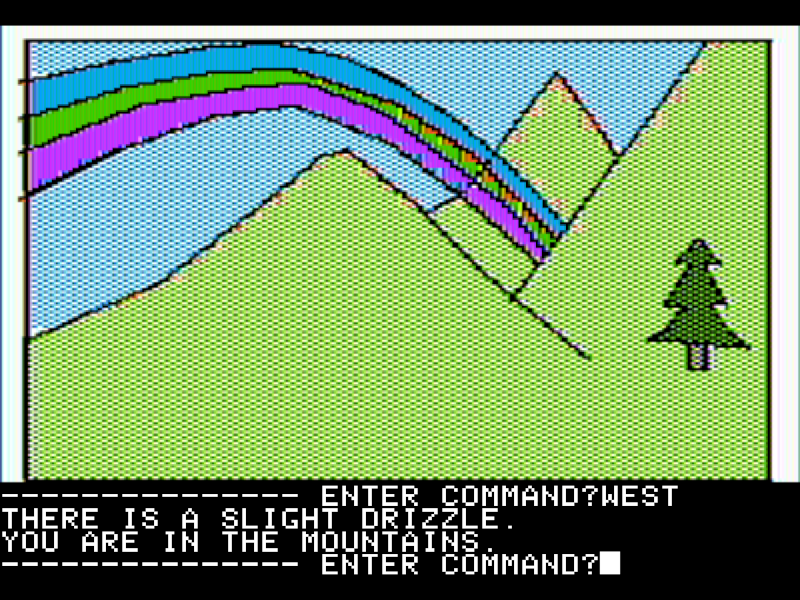
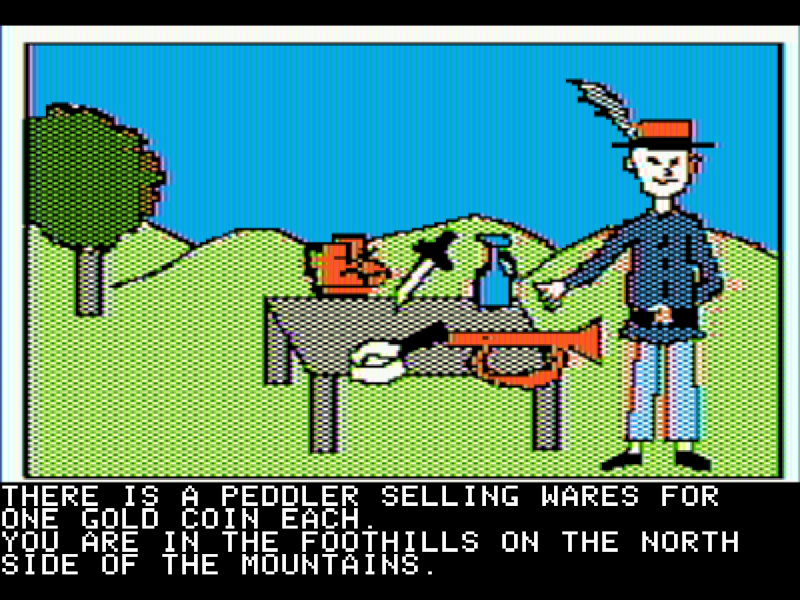
What is a bit unusual this time is that the game continues the Hi-Res series, with the first game in the series, Mystery House, being promoted as the first graphical adventure ever. Whether that is true can't be proven beyond any doubt, but some sources claim that this second entry in the series is the first graphical adventure in colour ever. That could be even more difficult to prove, but obviously there has been significant development between the first and the second game in the series. Wizard and the Princess looks much better than the first game, with some scenes even being quite pretty, and many things drawn on the screen looking much more realistic than in the first game.
The improved quality of graphics makes the game more immersive and, indeed, more fun to play. There are even cases where the graphical clues advance the game and are not simply pictures added on top of the text. There is still some room for improvement, but the trajectory is definitely going for the better.
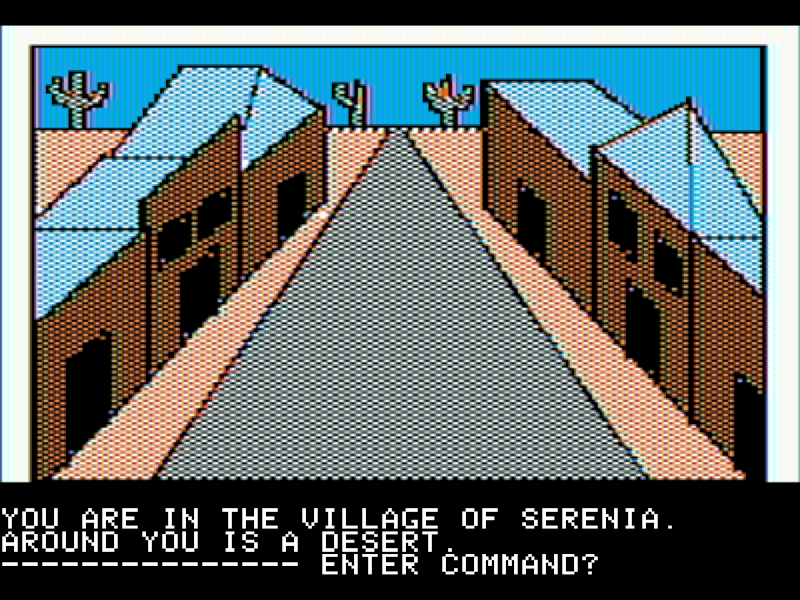
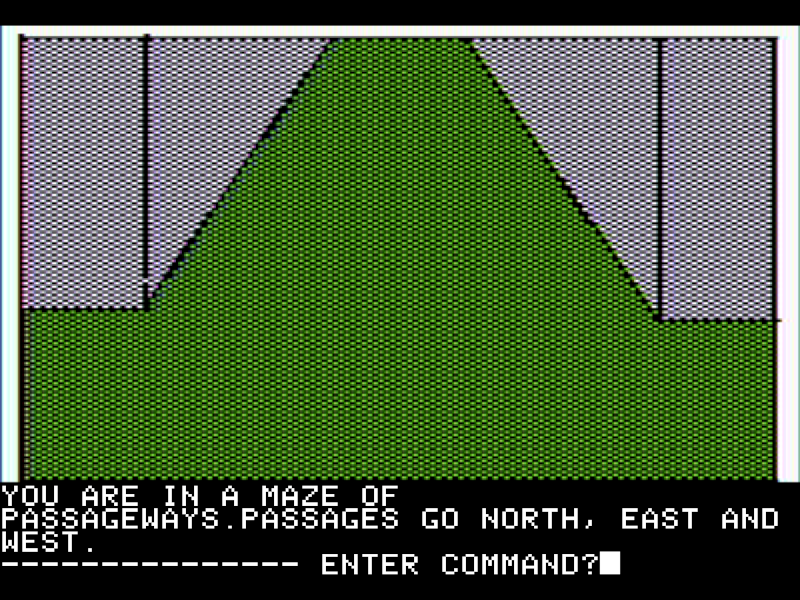
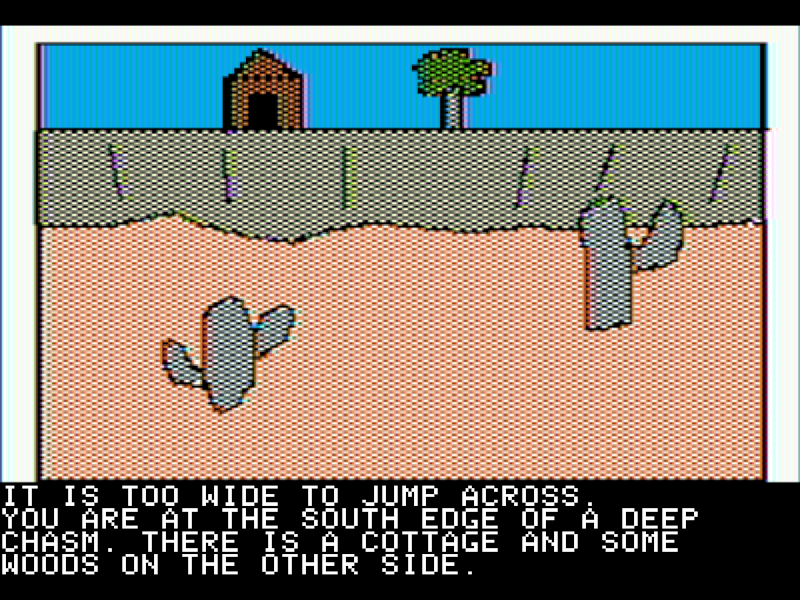
The game also has a much bigger scope this time around. The official description is still inflated, as the manual says: "even slight progress may take weeks." Bigger is better in many ways, but it is causing some problems too. Part of the problem is that the game has been designed to make the player get lost. That much is even stated in the manual. The game begins with a desert scene where many screens look exactly like the next one; there are no real directions, and so the player must resort to mapping on paper. There are many mazes or maze-like locations in the game. So if progress takes weeks (or a significant amount of time that is not inflated), it's not because the puzzles are so brilliant; it's because the game has been designed to lead the player astray.
It gets worse when factoring in that many screens in the game can cause an in-game death or just cause an unannounced dead end in the game. Simply not picking up something that is needed, or even doing the right thing at the wrong time, can result in the game becoming impossible to finish.
All that would be just fine, if the context were fair. Sadly, in Wizard and the Princess it isn't. Some things are simply too random. Many things can be deduced from all kinds of fairy tales, but there are cases that just don't make any sense. The worst thing is that in some puzzles items are used illogically; especially getting to an island has a series of steps that don't make much sense. Also, using spells and magic words is very random, and there's really no way to come up with those solutions without cheating. It certainly increases the challenge, but in a very bad kind of way. And it happens more than once that someone steals something, or inventory gets misplaced, so getting back something that has already been found is an overused exercise in the game.
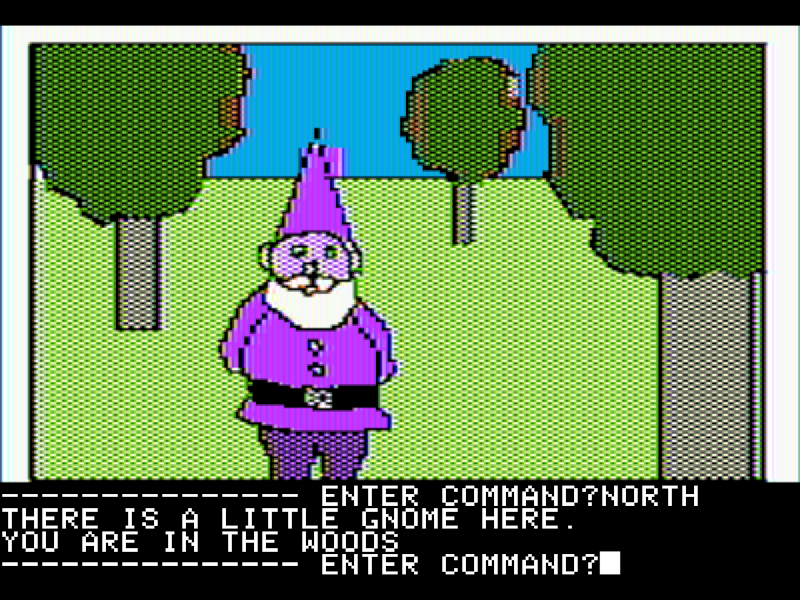
The overall narrative is clear, like described. But the story really doesn't advance. Some interactions in the game are very clear, and the player gets to go around in a lot of places, from hot deserts to tropical islands (which in real life probably would be quite far apart, but that's not the point). It's often clear what needs to be done, but the game rarely explains why it needs to be done. For example, a rowboat on the beach is clearly indicating that water should be crossed. But there's absolutely no reason given for what. It works by having the goal of looting everything everywhere and then trying to use those items elsewhere. But trying to learn even the most basic premise, such as why the wizard is interested in abducting the princess, is something that the game really doesn't volunteer to tell.
This, combined with random puzzles, creates a very bizarre atmosphere. In some cases the player needs to kill creatures that are encountered during the quest, but in some other cases they must be saved. Other than randomly trying, there's no way to know which approach is needed. And because a wrong action can cause a dead end, much saving and restoring is needed to get to the end.
The randomness is part of the parser interface as well. In many cases there is only one command that is accepted, and with those random magic spells it is often very hard to know where and when to use it. But quite unexpectedly, there are some other parts where the parser accepts even five very different kinds of commands to solve the puzzle. The most confusing case is when at one point the KILL command can be used to give an item and ends up not killing the target. And it's not even a bug or a glitch. And there's still the issue with inconsistent commands. ASCEND is accepted as an alternative for UP, but is DESCEND accepted where DOWN works? Well, of course not!
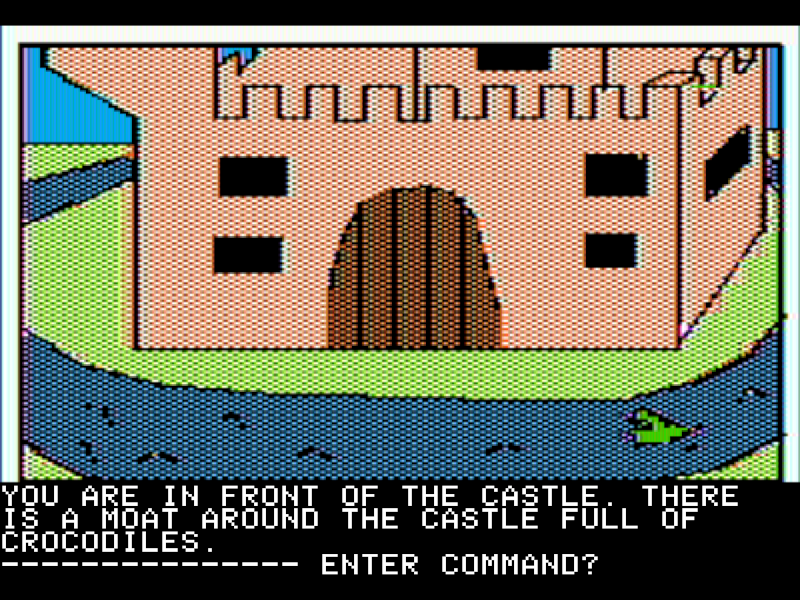
So overall, the "Hi-Res Two" is a much better effort than the first game was, but it is still far from perfect. And while it successfully addresses some of the problems in the first game, it also creates a load of new ones. At least there aren't any illogical scenarios like in the first game, where the player was able to exit the house he was supposed to be locked in but wasn't officially out of the house until unlocking the front door. Here many situations actually do make sense, at least in the fantasy setting – they are just poorly executed, with the player having no way to come up with the correct solution. Many puzzles work great, but the ones that don't kind of ruin the experience.
Maybe comparing the two Hi-Res games isn't the most sensible thing to do. Even though they belong to the same series, they have really nothing in common. But in that comparison, Wizard and the Princess is the clear winner. Not counting all the aimless wandering around, which is there by design, almost everything else is more polished this time than in Mystery House. Whether a fantasy world with talking animals is more attractive than a murder mystery is a matter of taste, of course. All things considered, Wizard and the Princess is an interesting game, which could be much, much better if only it didn't rely so heavily on the worst adventure game elements: mazes, deaths, and dead ends. Those are, of course, an acquired taste, so those who actually favour such game design are seeing Wizard and the Princess in a completely different light.
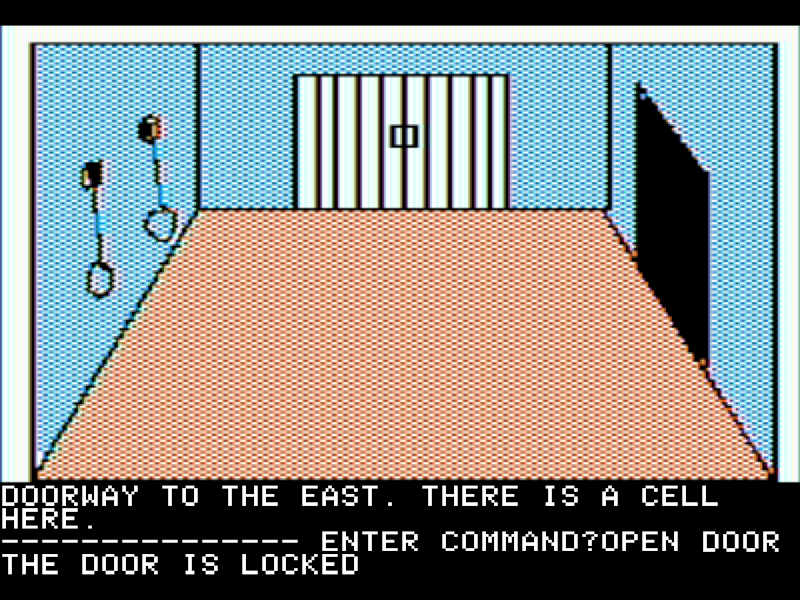
Image gallery